How to deliver PLA 20× faster & expand network coverage
2 million poles to manage, with no way to analyze them all at once.
A large Texas utility, responsible for managing over 2 million poles, serves one of the fastest-growing regions in the U.S. and faces constant pressure to keep its grid resilient against extreme weather.
To shift from reactive repairs to predictive resilience, the utility needed a fundamentally new way to model, analyze, and strengthen its network. High winds are a leading cause of outages, often exacerbated by vegetation interference and aging components. An early warning system provided only a one-way view of outages and lacked feedback loops to confirm whether corrective actions were effective.
Fragmented, incomplete datasets and a lack of visibility into third-party attachments meant the utility often relied on reactive fixes, replacing damaged assets like-for-like rather than designing long-term solutions. The utility had no platform to perform system-wide Pole Loading Analysis (PLA) across its millions of poles. It depended on outside contractors to conduct PLA on only 5 to 10% of the system annually, at a very high per-pole cost.
In recent years, the utility filed its first System Resiliency Plan (SRP) with the Public Utility Commission of Texas (PUCT), a nearly $3 billion commitment over three years to modernize the grid, harden infrastructure, and improve reliability.
A physics-enabled digital twin became the single source of truth.
The utility partnered with Neara to implement a physics-enabled digital twin of its entire network. Neara's platform centralized critical datasets, including LiDAR scans, GIS records, vegetation data, outage histories, and inspection field data, into a single, structurally accurate model capable of simulating how assets behave under real-world stress conditions such as high winds, high heat, cold snaps, and ice storms.
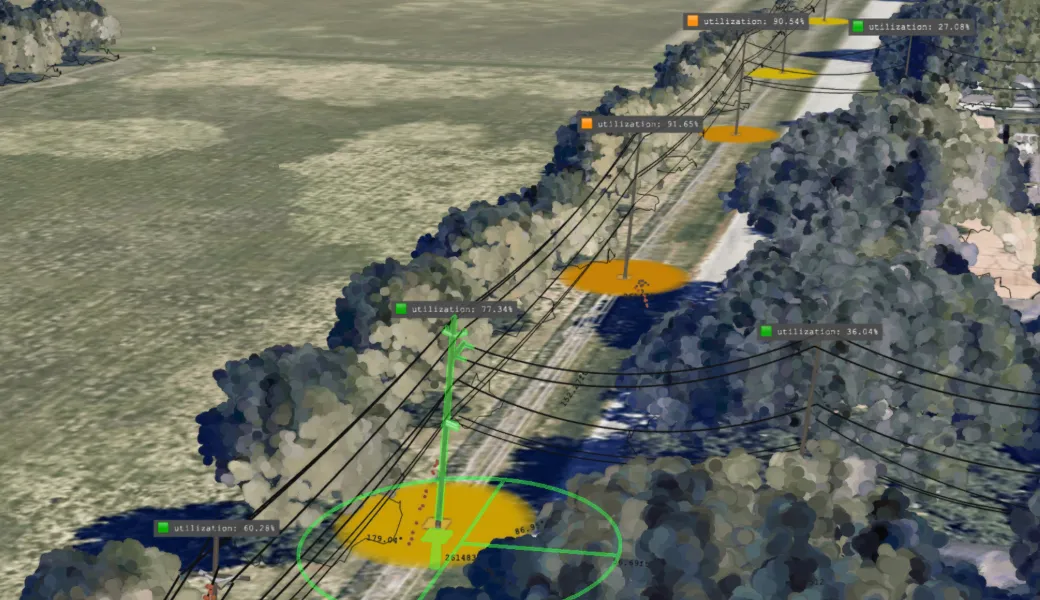
The physics-enabled digital twin replaced outdated paper-based records, providing a single source of truth that was both auditable and accessible across teams. With this unified view, the utility rapidly conducted pole-loading analysis across over 2 million poles, cutting costs and delivering PLA 20× faster while expanding network coverage by 10×.
The analysis highlighted at-risk structures such as overloaded poles and vulnerable cross-arms, while providing new insight into conditions previously obscured by fragmented data. Neara's integration with wildfire propagation models also strengthened the utility's risk modeling, improving the quality of data used in regulatory submissions and capital planning.
Field crews could visualize risks in 3D (conductor slapping, vegetation threats, or compromised poles) and prioritize work orders with greater accuracy. For the first time, decision-makers tracked whether mitigation efforts reduced outage risks, closing the loop between analysis, action, and outcomes.
PLA delivered 20x faster across 10x more of the network.
With Neara, the utility is advancing its vegetation clearance and fall-in analysis, bringing together asset health, vegetation conditions, and weather simulations into a single 3D view. The utility is reducing redundant truck rolls and focusing fieldwork on the highest-priority risks, improving efficiency and safety.
More accurate data reduces redline volumes and improves the foundation for Fault Location, Isolation, and Service Restoration (FLISR) enablement. For regulators, the physics-based outputs provide quantifiable, defensible evidence of risk reduction, tying mitigation efforts directly to measurable reliability improvements.
This 3D viewing and reporting framework is establishing a centralized resiliency reporting and dashboarding platform. Powered by Neara, this capability integrates the utility's customer outage data, outage causes, and Neara's resiliency analyses to auto-generate key metrics for internal teams, customer communications, and required regulatory reporting to the PUCT.
The result is a utility better equipped to anticipate and withstand extreme weather events while meeting regulatory obligations. Neara's solution has received strong internal endorsement from engineering, operations, and asset management teams.
See physics-based modelling in action.
Discover how Neara delivers engineering-grade clarity for the world's most critical infrastructure, or explore more results from utilities worldwide.