
How Essential Energy doubled network capacity of existing infrastructure
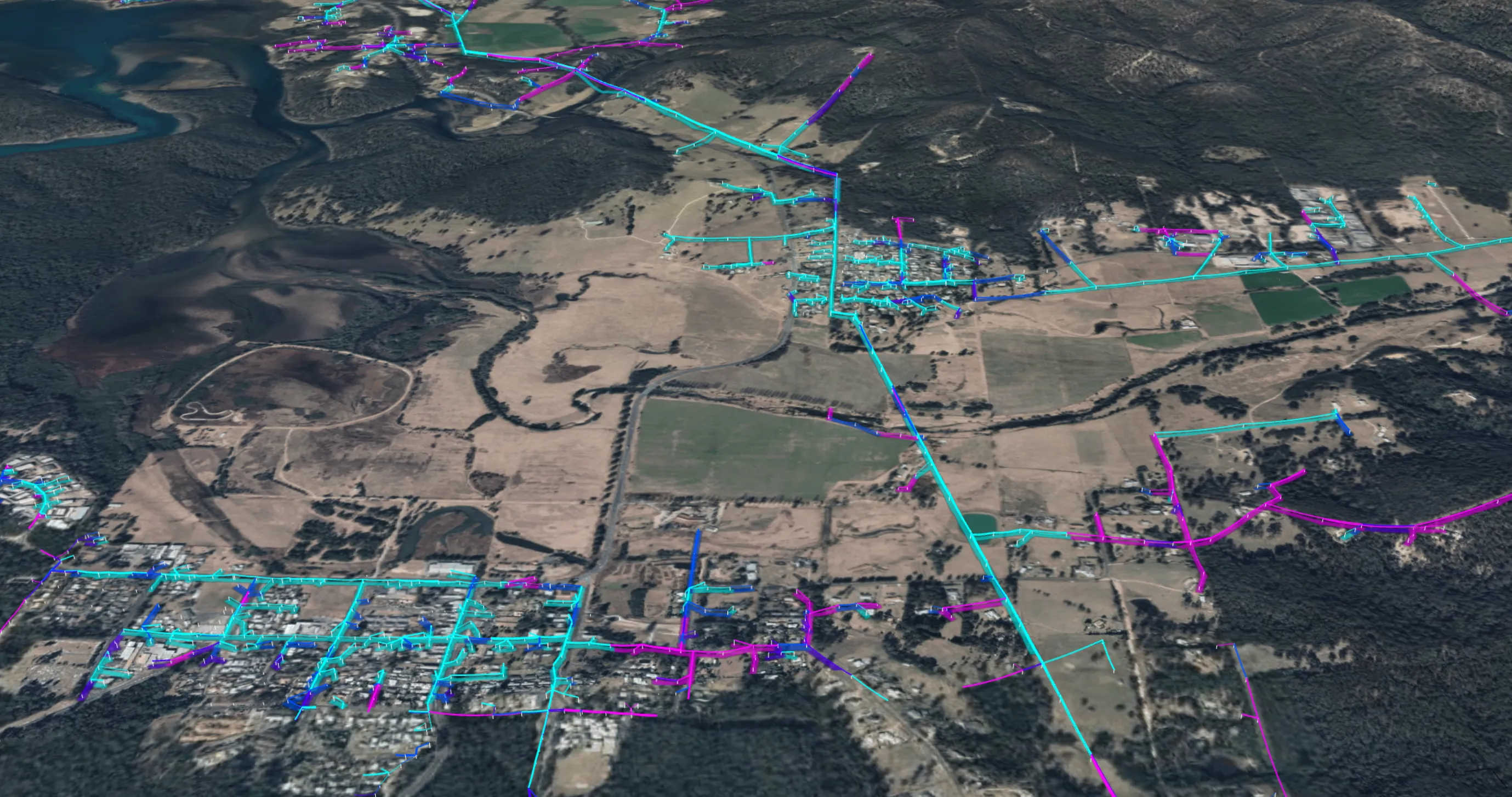
"We have found that the temperature our lines can operate at is much higher than we previously understood. Historically, we have had to apply a crude standard across the network. By modeling each span individually, we found that in many parts, the capacity is twice as high as we previously thought. "
John Cleland, CEO, Essential Energy
How do you double network capacity without building new infrastructure?
Essential Energy is one of Australia's largest electric utilities, powering nearly 900,000 customers. Their network comprises 183,612 kilometers of power lines, 1.4 million poles, 140,000 distribution substations, and 377 zone substations covering dry Far West regions, the snowy Australian Alps, and many coastal and sub-tropical regions.
Essential Energy needed a way to increase energy capacity across its existing network to support the country's clean energy transition. Many utilities perform line rating studies to assess maximum conductor current to understand how much energy capacity exists in individual spans, but extrapolating that across Essential Energy's more than 110,000 miles of network territory and 1.4 million conductors using traditional line rating methods would be prohibitively expensive and impractical.
The team needed to identify and diagnose bottlenecks, and model how freeing up capacity in one span would flow through and impact the rating of the next span. How much clean energy could they make room for using existing infrastructure, while upholding their commitment to maintaining downward pressure on consumer energy prices?
Individual span modeling revealed hidden capacity at scale.
With a sharp focus on their clean energy transition, Essential Energy sought a more scalable way to assess their network's available capacity in aggregate. Using Neara's 3D physics-enabled digital twin, Essential Energy discovered that they could double their energy capacity.
Essential Energy had already established a commitment to partnering with technology to innovate toward the network of the future and was already working with Neara to identify network-wide risks faster. Having applied Neara's granular simulation analyses across their network in service of several other use cases, the team at Essential was well-versed in the types of analyses the platform could facilitate.
Essential Energy's industry-leading vision, underpinned by Neara's platform, led the team to investigate how they could get more out of their existing distribution assets to enhance asset utilization and accelerate renewable energy integration.
Double the capacity found in existing assets, without a single new line.
As a result, the team was able to identify and unlock significant collective capacity across their existing assets that would significantly accelerate the clean energy transition while bringing down the cost, since they would not need to build new transmission to support the generation.
This development represents significant cost savings and a major step forward for the country's decarbonization journey. The utility is reducing redundant truck rolls and focusing fieldwork on the highest-priority risks, improving efficiency and safety.
For regulators, the physics-based outputs provide quantifiable, defensible evidence of risk reduction, tying mitigation efforts directly to measurable reliability improvements. More accurate data reduces redline volumes and improves the foundation for Fault Location, Isolation, and Service Restoration (FLISR) enablement.
See physics-based modelling in action.
Discover how Neara delivers engineering-grade clarity for the world's most critical infrastructure, or explore more results from utilities worldwide.