Utility defers 25k pole replacements
25,000 condemned poles, and no way to tell which really needed replacing.
The utility had made a regulatory commitment to identify and remediate any poles at high risk of failure across their network. They had to prove which poles were in especially bad shape to justify the investment decision, but they only had qualitative field reports and their equipment age-based methodology to explain the logic behind which poles needed replacement.
Initially, they estimated that 25,000 to 30,000 poles needed to be retired and entirely replaced. The cost had become a point of contention with their regulator, and the asset management team needed to both de-risk problem poles and also right-size and justify the replacement cost.
Physics-based analysis proved most condemned poles were still structurally safe.
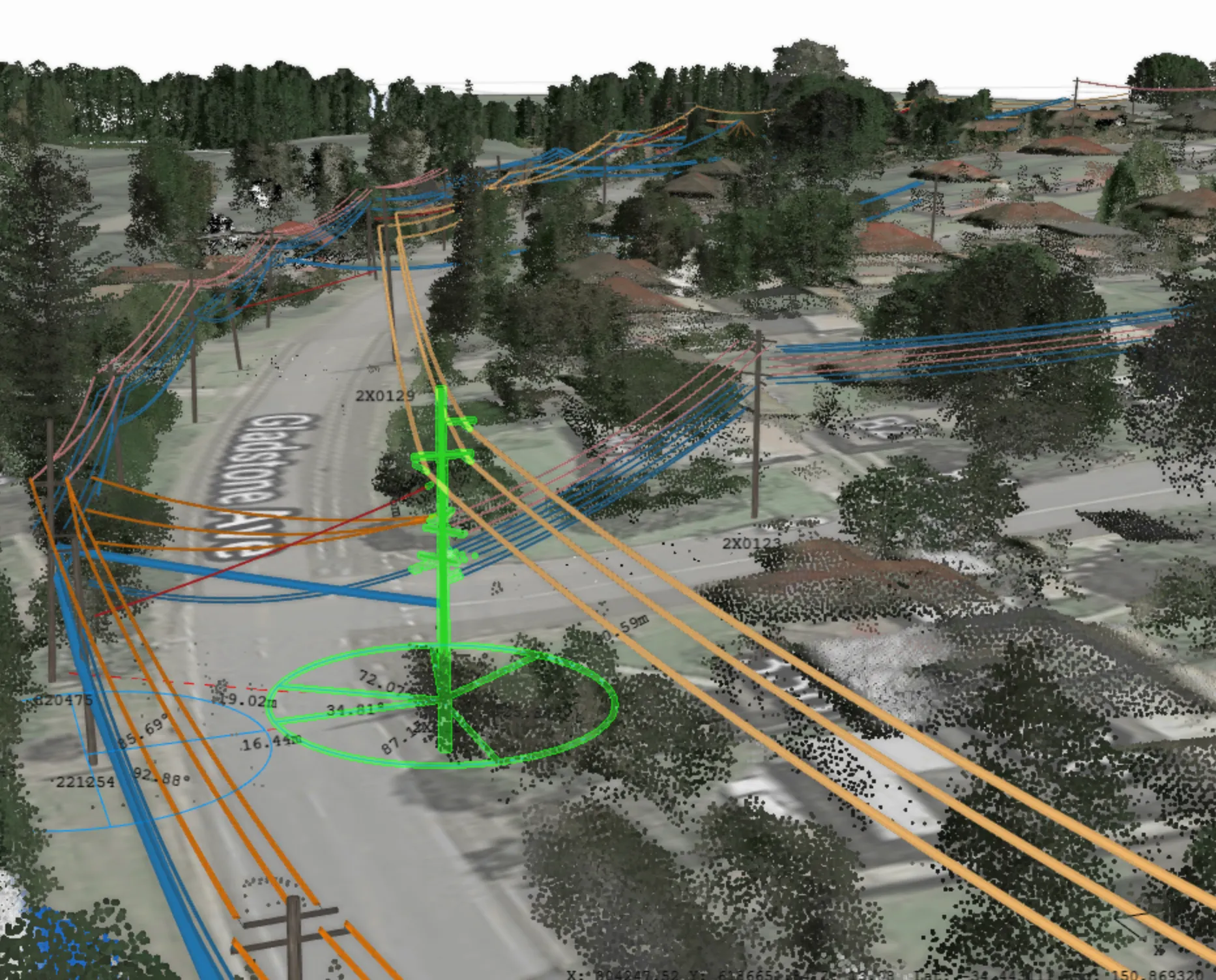
Using Neara's physics-enabled digital twin, the utility proved that a large portion of the condemned poles were still structurally stable and suitable to remain in service for a defined period.
Neara helped the utility to expedite risk identification work 10x faster compared to traditional methods. The analysis included Finite Element Analysis and various severe weather simulations, producing evidence that the utility shared with their regulator to prove it was safe to leave much of the initially condemned poles in service.
The number of condemned poles was significantly reduced to 4,000 poles, saving millions of dollars without compromising safety or network integrity.
84% of replacements deferred without compromising safety.
The utility used Neara's predictive modeling software to perform tip-loading analysis across every pole in the network. The analysis included Finite Element Analysis and various severe weather simulations, producing evidence that the utility shared with their regulator to prove it was safe to leave much of the initially condemned poles in service.
The utility has now entirely digitized its pole tip-loading analysis using Neara's technology to continually run fast cost-benefit analyses across all risk and asset management programs. The utility is reducing redundant truck rolls and focusing fieldwork on the highest-priority risks, improving efficiency and safety.
For regulators, the physics-based outputs provide quantifiable, defensible evidence of risk reduction, tying mitigation efforts directly to measurable reliability improvements. More accurate data reduces redline volumes and improves the foundation for Fault Location, Isolation, and Service Restoration (FLISR) enablement.
See physics-based modelling in action.
Discover how Neara delivers engineering-grade clarity for the world's most critical infrastructure, or explore more results from utilities worldwide.