How one utility identified conductor clash risks 10x faster
A 3-year compliance commitment with no efficient path forward.
An Australian utility faced a challenge in fulfilling its regulatory commitment to identify and resolve conductor clashing issues across high wildfire-risk areas. The utility was obligated by regulations to identify and solve conductor clashing issues in high wildfire-risk areas.
The utility struggled to efficiently build comprehensive models using LiDAR data and asset libraries and to promptly assess conductor clash risks and generate reports. They originally scoped the project to take 3 years to complete without access to the right tools.
A physics-based digital twin replaced months of manual assessment.
Originally projected to take 36 months, the utility completed the project in just 4 months after implementing Neara's platform.
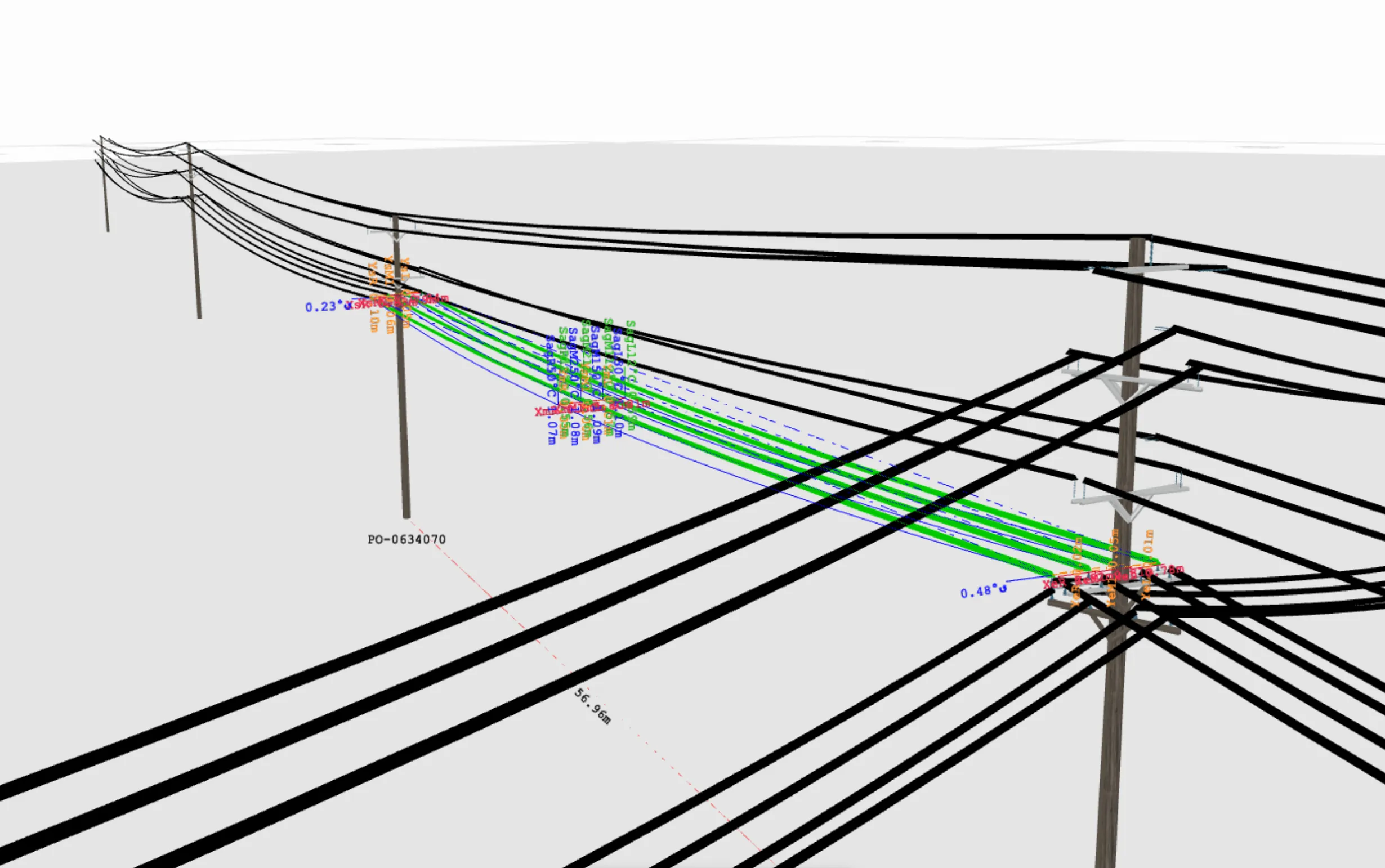
Neara developed a detailed 3D physics-enabled digital twin of the high wildfire-risk zones, simulating comprehensive conductor clashing analyses across all conductors. Leveraging LiDAR data and asset libraries, Neara constructed the model and verified conductor and pole specifications.
Conductor clash risk identified 10x faster. Compliance achieved in 4 months.
By using Neara's platform, the utility was able to identify conductor clash risks 10x faster. The utility reduced redundant truck rolls and focused fieldwork on the highest-priority risks, improving efficiency and safety.
The platform simulated conductor clash scenarios based on physical factors such as cable tension, type, width, wind speeds, and temperature impacts on sag. This approach allowed the utility to swiftly prioritize and mitigate network risks, ensuring compliance and enhancing overall grid resilience.
The rapid assessment not only facilitated compliance with regulatory obligations but also helped to address network vulnerabilities. The utility has now expedited risk identification work 10x faster compared to traditional methods.
For regulators, the physics-based outputs provide quantifiable, defensible evidence of risk reduction, tying mitigation efforts directly to measurable reliability improvements.
See physics-based modelling in action.
Discover how Neara delivers engineering-grade clarity for the world's most critical infrastructure, or explore more results from utilities worldwide.